When a brand claims AI can see it, what justifies believing that? Three months of tracking split "visibility" into four indicators of very different weight. Most brands are measuring the wrong one.

A
AEO / GEO
/

Three months ago I thought I was answering a straightforward question: how do I get AI systems to cite my content? Three months in, citation turned out to be the easy part. The harder question is this. When a brand claims that AI can see it, what justifies believing that?
I started tracking what happened after I structured my site, and the early signals were encouraging. Some platforms found the site. Some cited articles from it. Some pieces began appearing in new search results.
If I had stopped there, I could easily have concluded that the techniques everyone writes about work.
What made me stop was how easily the results arrived.
Ask the same question a few times and the answers begin to diverge. Cited today, gone tomorrow. Each platform behaves differently.
At first I assumed the site was simply too new to produce stable results. Then I went looking, and found this is not unique to me. SISTRIX, tracking six countries over 17 weeks, found that the sources AI systems cite keep changing, and are far less stable than people assume. My observation rests on a small sample and theirs on a global one. Both point the same way: citation is a signal that keeps moving.
If the signal keeps moving, the question worth answering changes. Which of these movements should I believe?
This is also why the experiment had to happen outside my job. Inside a company, even one operating under strict security policy, every site update carries several requirements and several departments changing things at once. Isolating cause is close to impossible. I needed an environment that was small but had exactly one decision line: change one thing at a time, date every change, and watch across several platforms at once.
I had misunderstood what "being cited" meant
I had been treating citation as a milestone. Then the inconsistencies piled up.
Some content was found and never turned into an answer. Being visible and being used as a source are separate events.
Some content became part of an answer without changing how the system understood the question.
Once, an AI cited my article and then built its answer on a framework that had little to do with the point I was making. A reader would have seen my work credited and read a conclusion I had never argued. Being cited and shaping the reasoning turn out to be separate again.
And when I watched several platforms at once, even "did the answer change" turned out to be unsynchronized. Some had started to reason the way I framed the problem. Others had not moved at all. Watch one platform and you will mistake a local fluctuation for a trend.
Visibility runs deeper than it looks
I had been collapsing four different phenomena into one word. Being found. Being cited. Changing how the system reasons. Producing a consistent answer across platforms. Four things, carrying very different weight, all filed under "visible."
Pulled apart, they give four separate indicators.
One: can AI find me? Discovery and indexing.
Two: does AI put me in the answer? Repeatedly, not once. (This counts sources and frequency. Whether the system trusts the source is a separate layer, which I will come back to another time.)
Three: has AI started to reason about the problem the way I frame it?
Four: are different AI systems converging on the same answer?
Most brands are working on the first two.
The first two respond to technique. Fix the structure, submit for indexing, get the format right, and you will be found and quoted. A monthly report counting how often AI systems cited you looks like progress. It may tell you nothing about whether any of those citations changed how a system understands your product. I have watched an AI cite my article, place it first among its sources, and then produce an answer that had nothing to do with my argument.
The third indicator asks something else: has the system's understanding of your field, your brand, your product actually shifted? A company can score full marks on the first two and zero on the third. Your content appears on several platforms, and you have changed nothing.
That is the indicator that touches long-term competitiveness. What decides a brand's position is whether, every time the system answers a question in your domain from now on, it reasons through your frame.
Asked which of the four matters most, I would say the third. Whether AI's judgment moves in the direction you intended is the line between being seen and beginning to influence what gets said.
The first two mean AI can see you. The third means you are becoming a source it leans on. That is my judgment, not a demonstrated conclusion. Three months of observation have made me more confident in it, not certain of it.
The fourth — cross-platform convergence — I cannot claim to have seen yet. My working assumption is that the thing worth tracking over time is whether the answer you want appears consistently across several systems at once, because a single platform's result can be manipulated, while movement across an ecosystem is much harder to fake. That will take longer to establish. I am still watching.
Why these four cannot be averaged into one score
Someone reading this is already imagining a weighted "AI visibility score." Don't.
The four do not move together. You can max out the first and score zero on the second. You can clear the second and only discover at the third that the answers being produced are not the ones you wanted. You can watch the third begin to shift, get the answer you were after, and find the first has dropped to no citations at all.
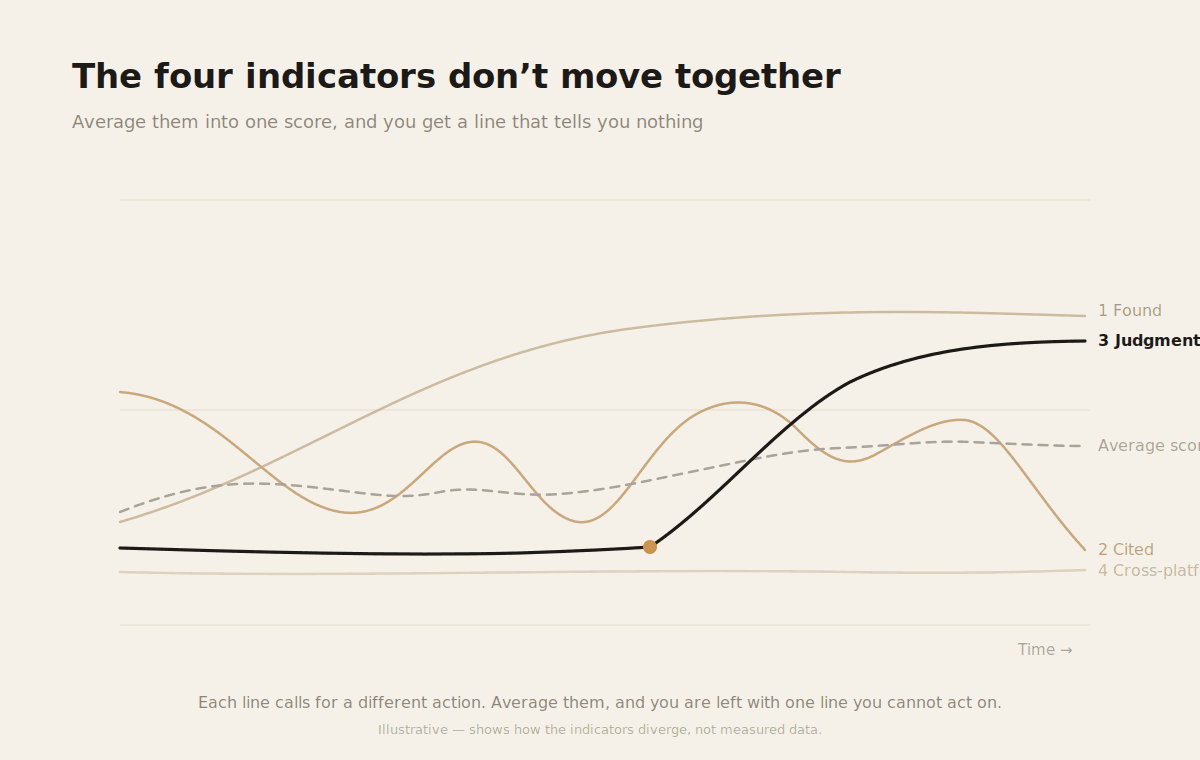
A useful metric points to an action. Four indicators that demand four different actions, averaged into one number, produce a figure that maps to no action at all.
So what do you do on the next day
If your team is using "number of AI citations" as its single KPI, resist the jump from the number to a strategy. Ask the prior question: what does this number represent?
That you were found? That you made it into an answer? That you changed how the system reasons about the problem? Those three require entirely different responses.
Before optimizing for AI visibility, define what each number you are chasing actually proves. Skip that, and every strategy discussion that follows is built on a number nobody has understood yet.
The next question: how does AI decide whose frame to adopt
Three months ago I thought I was testing whether structural techniques improved AI visibility, and collecting a tracking method along the way. What I came away with is a way of deciding what a brand should be measuring at all.
It also left a question I cannot yet answer. There is a pattern in being cited without being adopted, and it points at something underneath: whether an AI system takes on a source's framing, and whether it puts that source in the answer, appear to be governed by different things. Getting into the answer may take little more than being retrieved and being relevant. Getting a system to reason your way takes something else.
What is that something else? On what basis does AI decide to adopt one source's frame over another's?
That is what the next piece is about.
(This article is itself a sample in the experiment it describes. Where it lands across those four indicators is the next round of data.)
閱讀更多文章